by David Galster | Nov 11, 2019 | CS: East Front III (WIP), East Front III: Marshall Budyonny's Dacha, Scenario Design

My fellow Vsadniks,
This new CS Legion article series, “Marshall Budyonny’s Dacha” covers the early part of the Red Army’s response to Hitler’s Operation Barbarossa in 1941. The articles cover various aspects of scenario design, and some key historical points. This first article deals with a guide on how to research the details needed for Campaign Series scenario design.
Scenario Research Problem with Barbarossa
Operation Barbarossa was very massive, with numerous armies, dozens of corps, and hundreds of divisions. WWII war historians like David Glantz have written volumes about the 1941 invasion, but the discussions are about movements and actions of armies and corps. Occasionally, a division is identified and discussed, but this is the exception.
The new game, Campaign Series EFIII is not suitable for simulating these very large operations. It is much more geared to scenarios with maybe a few regiments on each side, at most a couple of Divisions per side. Details of the lower level unit identification, specific combat locations and times, are not easily found in the narratives.
For example, David Glantz wrote “Barbarossa Derailed, The Battle for Smolensk, 1941 Volume 1.” It is an excellent reference, but does not provide the level of detail needed for good CSEFIII scenario design.
A narrative example in Barbarossa Derailed is as follows: “Boldin, to attempt to organize a counterstroke in accordance with DP-41. Assigning Boldin nominal control of Khatskilevich’s 6th and Mostovenko’s 11th Mechanized, as well as Major General Ivan Semenovich Nikitin’s 6th Cavalry Corps, he ordered the forces of the three mobile corps to mount a concerted attack northward from the Belostok region towards Grodno. . .”
Notice that there are no divisions, regiments, battalions, etc. identified. Where were some of the firefights between German and Soviet forces? The area between Belostok to Grodno is huge, as these cities are 50 km apart. On an EFIII map this would be about 200 hexes. Further, this action spanned two or three days. This narrative is simply not specific enough to design a historical EFIII scenario.
EFIII Campaign Model
This problem can be overcome by using a systematic research method. The first step is to identify a specific campaign within the overall Operation Barbarossa.
Then on the German side, identify the Army Group, Armies, and Corps.
On the Russian side, identify the Front, Armies, and Corps. There were certain identifiable, smaller “campaigns” within Barbarossa. For the German Army Group Center vs Soviet Western Front, the advance on Minsk comprises the first phase, and then afterwards the Smolensk Campaign. In the south, there was a huge tank battle in the Lutsk-Brody-Dubno triangle. These may be artificial constructs, not always found in the literature, but they provide a framework for further research.
Using the narrative example, and studying the book’s Appendix B OOB tables, one can find that the Western Front had 11th Mechanized Corps. This Corps consisted of 29th and 33rd Tank Divisions, and 204th Motorized Division.
We can pick one of these, perhaps 29th Tank Division for a scenario. We can do Russian language searches on it, like 29-й танковая дивизия, in Google, and translate these back to English and find regiment and battalion numbers. Perhaps, in Wikipedia articles, we might even find a battle narrative that provides further detail.
Similarly the 6th Mechanized or 6th Cavalry Corps can be researched for historical information.
One of these should have some interesting action that can be fairly well defined, in terms of units involved, specific locations, and specific times.
A Corps level commander on the Soviet side might have Wikipedia articles. They might even contain some of this battle information. Primary source data, such as a “Kriegstagebuch” might offer some additional information.
Similarly, and perhaps more easily, we can determine possible German Divisions involved.
According to Glantz’s text:
“The few tanks, cavalry, and infantry that survived the gauntlet of intimidating air strikes arrived in the Grodno region long after Hoth’s panzers had raced eastward toward Vilnius and fell victim to devastating infantry ambush and antitank fire from German Ninth Army’s advancing V Army Corps.”
The Divisions of V Army Corps can be found in Appendix B OOB tables: 161st, 5th, and 35th Infantry Divisions. Similar internet research on these Divisions might yield some specific relevant information.
Conclusion
So the basic “Campaign Model” method is to understand the overall picture of a “campaign,” and to know the Army Group, Front, Armies, and Corps involved. (Both sides)
Then from the operational narrative, identify specific Corps actions, general area, and timing.
From Corps designations, list the Divisions involved.
Research these Divisions and perhaps commanders in more detail, to find specific and relevant units,locations, and times.
A sketch of the campaign is useful:

References
“Barbarossa Derailed, The Battle for Smolensk, 1941 Volume 1”, David Glantz
Marshall Semyon M. Budyonny
Marshall Budyonny’s Dacha is the latest series of articles by David Galster that will cover various aspects of scenario design, and some key historical points for Campaign Series: East Front III.
by Crossroads | Aug 7, 2018 | CS: East Front III (WIP), Developer Diary, Orders of Battle
I have just finished putting together a second iteration of the Finnish order of battle for Campaign Series: East Front III, a platoon-scale tactical wargame covering battles in WW2 Eastern Front in 1939-1941. This blog post supplements the previous German and Romanian OOB posts by Jason Petho, and Scott Cole, respectively.
Finnish Army in Campaign Series: East Front III
As those familiar with history know, Finland participated in the Second World War battling the Soviet Union at two occasions, and then once against Nazi Germany pushing them out from the country. In this regard, Finland was placed in the unusual situation of being for, then against, then for, the overall interests of the Allied powers.
A lone guard on skis. Petsamo 1940.02.01 (SA-kuva.fi)
As East Front III 1.0 will cover the years 1939-1941, the relevant conflicts are the invasion of Finland by Soviet Union in 1939, known as Winter War, and the subsequent Finnish participation in Operation Barbarossa, dubbed Continuation War. The war against Nazi Germany to liberate Finnish Lapland will be featured in an East Front III sequel covering the years 1944-45 and is not covered in this article. [hr]
Winter War Order of Battle
The Winter War began with a Soviet invasion of Finland on 30 November 1939, three months after the outbreak of World War II, and ended three and a half months later with the Moscow Peace Treaty on 13 March 1940. This provides a relatively short period of time in regard of Order of Battle design, and will be implemented as a holistic, independent data set. In addition to Finnish Army, the Swedish Volunteer Corps will be added as another independent formation to game’s data set under Finland nation ID 41.
Finnish Army
Finnish Army will be covered in detail from Army Corps to Platoons, as there were no Army level formations in Winter War. There will be generic formations available under the standard TO&E information, with each and every historical division also represented in the data: Being an artillery reservist myself, I took an additional effort to depict each and every historical artillery formation to the game as well, from Artillery Regiments to independent Batteries. As Winter War was a short but violent battle, each artillery formation will additionally be depicted as how they started the war, and how their strength was in February 1940, with one more month of war to go:
Swedish Volunteer Corps
While most WW2 history geeks are aware that Sweden maintained their neutrality during the conflict, a less known fact perhaps is that during Winter War, Sweden simply declared themselves a “non co-belligerent” state instead. In other words, they did not maintain a strict neutrality as such. Perhaps the concrete example of Sweden’s aid to Finland at this critical hour were the Swedish Volunteer Corps. Svenska frivillligkåren (in Swedish) were roughly a Brigade sized, well equipped formation, with some 9 650 Swedish volunteers choosing to join Winter War together with Finland. As part of the Corps, Sweden also sent approximately one third of their most moder airforce fleet (Gloster Gladiator fighters and Hawker Hart bombers) to Finland to accompany the volunteer pilots.
“Finland’s Cause is Yours – Come join the Volunteer Corps!”
Swedish Volunteer Corps played an important part occupying a wide front in Finnish Lapland, with the brave young volunteers willingly having risked their life for the sake of their Nordic neighbor. To honor their commitment, the Swedish Volunteer Corps are deservedly a part of the Winter War order of battle as an independent and full organization: [hr]
Continuation War Order of Battle
The Continuation War began some fifteen months after the end of the Winter War, with Finnish Army commencing their attack against Soviet Union in 10 July, 1941. The war would continue until September 1944, when Finland agreed to a cease-fire with USSR. For the purposes of East Front III 1.0, the initial Finnish Army formations will cover the year of 1941. In addition to Finnish Army, no additional formations will be added to the data set, with Finnish Volunteer SS Battalion being a likely candidate for addition to a future East Front III sequel covering the years 1942-43. It is true parts of the Finnish volunteers fought already in 1941 in Waffen-SS division Wiking, but as they were integrated into the unit, instead of being an independent formation as the III/Nordland was (as of January 1942), they will not be depicted in the data sets for the first year of war. Looking at the order of battle data, this time there will be a complete Finnish Army formation available from the Army level down to Platoons, again with generic TO&E based generic formations, and each and every division depicted in all their detail, too: As with Winter War, all historical artillery formations are covered as well. With the hodgepodge set of various makes and models of artillery pieces, this was my favourite part of the OOB design, and I do hope you enjoy the historical details included in the game! As a little something to look forward, all this detail in order of battle design will make it possible to add a plethora of nice little detail to the game. Here’s the Finnish 3D unit bases with nine different designs available at the time of writing this article! Finnish 3D unit bases (work in progress), from left to right:
- Generic Finnish Army
- Winter War Finnish Army
- Winter War Swedish Volunteer Corps
- Continuation War Finnish Army
- Continuation War Armored
- Finnish Volunteer SS Battalion (not included in 1.0)
- Winter War Finnish Air Force
- Winter War Swedish Volunteer Corps Air Force
- Continuation War Finnish Air Force
[hr]
Conclusion
As Jason pointed out in his German OOB blog, Order of Battle creation is a labour of love with many challenges part of the job. I do concur with him that, with addition of Winter War and Continuation War Finns (and Swedes!) to the game database, we’re making every effort to ensure that you will have the most accurate organizations to build your East Front scenarios, once the game is out!
by Scott Cole | Mar 6, 2018 | CS: East Front III (WIP), Developer Diary, Orders of Battle
I’m putting together the Romanian order of battle for Campaign Series: East Front III, a platoon-scale tactical wargame covering battles in WW2 Eastern Front during 1939-1941. This blog post supplements Jason’s recent German OOB post by revealing what’s in store for one of the minor Axis allies.
Romanians in Campaign Series: East Front III
I believe the common perception of the Axis Minor Allies performance on the East Front is accurate to a degree but probably too harsh (excepting, of course, the well-regarded Finns) and the Romanians prove the point.
The Romanians fielded a mostly illiterate army of conscripts with inadequate transport and fought the entire war at a constant disadvantage in equipment and weaponry. In short, they were fundamentally unsuited to a mechanized and ideological war on the Russian steepe. On the other hand, the Romanians provided the Axis its third largest army and captured Odessa with limited German ground support (though this battle was a drain on Luftwaffe assets). Some may debate the value of the costly Odessa campaign but the Soviets viewed its recapture in 1944 as significant enough to merit a 324-gun salute of 24 salvos in Moscow. This was a rare honor and only ordered after significant achievements such as the capture of Bucharest, Budapest and Vienna (Ref – Stalin’s Orders of the Day).
The Romanian Army in World War II was unsuited for a mechanized, technical and ideological war but thought should be given on how far the Germans could have advanced in the south without Romanian support. I tend to think that the Germans bear much of the blame for overly ambitious plans relying on resources that were not available or up to the task.
Romanian Order of Battle 1939-1941
East Front III will cover the period from January 1939 to December 1941 and anyone interested in the Romanian effort in WW2 should keep in mind that the Romanian Army was constantly being destroyed then reconstituted. Mark Axworthy describes these changes occurring in three waves. The Romanian army that started the war “was rendered hors de combat at Odessa and Stalingrad or in the Crimea….” and the army raised to replace these losses in 1943-44 were lost by the time the Romanians defected to the Allies in 1944. A final wave was raised from training formations to be used as cannon fodder by the Russians in 1944-45.
In terms of East Front III, I won’t have to worry about the 2nd and 3rd waves but there is some complexity in the early Barbarossa OOB as some Romanian formations were trained, just prior to hostilities, by the German Army Mission (Deutsches Heeres Mission in Rumanien, or DHM) and the German air force mission (Deutsches Luftwaffe Mission in Rumanien, or DLM).
I have created separate infantry platoons to represent the 5th, 6th, 13th, 18th and 20th Infantry Divisions which were first selected for initial conversion to German training and tactical systems but have yet to decide on how to name these platoons. Separate platoon designations for each of the divisions is too unwieldy so currently, I’m thinking of adding the DHM acronym to the platoon’s identifier. I haven’t talked with Jason on how this will come out in improved factors but think these units will have a little better morale factors (to simulate better German tactics and the attempt to instill NCO leadership) while scenario designers may want to give a Romanian side consisting of DHM trained troops a higher supply factor than usual. This doesn’t mean DHM trained troops had a better supply system (German supply support to their Romanian allies can most charitably be described as stingy and in times of crisis should be described as antagonistic).
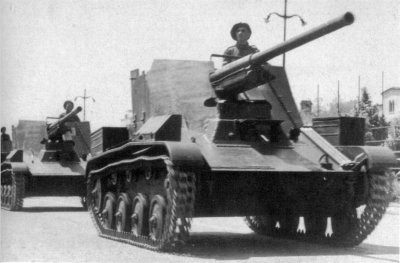
A Romanian A TACAM T-60 during the National Day parade, 10 May 1943. (c) Public Domain
Initially, the Romanian artillery corps resisted DHM training methods though after the Odessa fiasco of uncoordinated artillery support causing friendly fire casualties along with a general inability to suppress Russian defensive positions they became more receptive.
The 1st Armored Division serves as the best example of the benefits of DHM training. While serving under the German 11th Army the 1st Armored Division was very effective, especially when operating as the armored unit of the German LIV Corps by dislodging Russian defenders on the Cornesti Massif and pushing them back over the Dnestr River. When the armored division was transferred to the Romanian V Corps and were assigned the task of cutting off Odessa to the east they suffered high losses as the Romanian infantry of the 15th Division had not been trained to operate with tanks. In fact, during the Odessa campaign the 1st Armored Division was always subordinated to infantry corps and ordered into ill-coordinated frontal assaults on fortified positions.
I’m sure EF fans will be pleased on the attention to detail we are giving to the Romanian OOB. We are moving beyond a stock infantry and engineer platoon and will cover a wide range of the Romanian infantry available: border guards of the Frontier Division (Axworthy “well-trained, long-service troops”); Royal Guard infantry (“reliant on conscripts but had esprit d’corps”); Naval infantry, Fortification Division troops, Vanatori or mountain troops and much more. The engineers are broken down into mine layers, construction, rail, bridging and even work shop troops.
Romanian minelayer Amiral Murgescu (c) Public Domain
For scenario designers interested in operations in and around the Black Sea and Danube Delta the new OOB file covers every ship in the Romanian Navy to include all the river monitors, torpedo and gun boats along with all the major coastal defense gun batteries and associated AA batteries if one wants to include such locations as Constanta and Sulina.
Conclusion
Jason designed a lot of the Odessa scenarios for the original EF games and he’s planning on updating them with not only the new Romanian OOB but also on the Russian side. Russian Naval infantry will be represented (they played a role not only in the original Odessa campaign but the liberation of Sebastapol in May, 1944. I think he’s also going to add the “Odessa tractors” which were agricultural tractors with armored plate.
Finally, I urge anyone interested in the Eastern Front to take the opportunity of picking up Mark Axworthy’s excellent Third Axis Fourth Ally. Even if you interest in the Romanians is limited it will provide you with a lot of detail on operations in Army Group South. The book is long since out of print and prices online can be prohibitive but if you find a copy at a library or yard sale going for cheap, it is a must buy.
by Jason Petho | Jan 13, 2018 | CS: East Front III (WIP), Developer Diary, Orders of Battle
Early mock-up of East Front Main Menu with “panzergrau” color scheme
The Campaign Series East Front Order of Battle files (*.oob/OOB) were originally created by Talonsoft for the first release back in 1997. Since then, they have been continuing added to and expanded upon with each successive release, including the various Matrix Updates. Unfortunately, this has lead to a mish-mash of organizations, ID coding and an incohesive mess. Instead of attempting to correct and massage the existing data, it has been decided to start from scratch for East Front III.
A major enhancement with the order of Battle files, is the extra numeral in the platoon ID from five to six characters. Unfortunately, this nullifies all the previous OOB files, but this addition provides thousands of unique identifiers (UID) that can used for creating the new platoons. The new UID capabilities have provided the opportunity to fill in the proper strength point levels for various platoon types to ensure that the organizations being created are more accurate than ever before.
The enhanced UID’s have also allowed me to create different branches within the organizations, which will display unique chits on the map. The new branches are;
- Heer,
- Luftwaffe,
- Waffen-SS,
- DAK, and
- Grossdeustchland.
Adding these new branches have burned through a lot of the new UID’s, but I believe it will be a visual delight to see on the battlefield when playing.
East Front III 1939-1941 will have certain units that are easily indentifable with the 2D and 3D icons/bases. Part of this means building these specific units with unique ID’s and structures (from the platoon up, of course). Here’s a sample of Grossdeutschland circa September 1940:
Snippet from Platoon18.oob
German Order of Battle 1939-1941
East Front III will cover the German OOB organizations that span between January 1939 and December 1941. Additional dates will be covered in the future East Front III DLC’s.
Apparently Amazon delivers on Sunday!
Creating the organizations for the Germans is a challenge. Even during the three-year time span, the various structures changed on a regular basis for all branches. The panzer and infantry forces changed considerably between how they started the war in September 1939 to how they looked as they advanced on Moscow in the winter of 1941.
Infantry Divisions
When looking at the Infanterie Divisions in the OOB files, you will see that I did not detail each division, but each group of divisions that were created in the waves (welle). I have made an effort to recreate each welle and updated it accordingly as the war progressed. Each division in the welle is based on the authorized Tables of Organization & Equipment (TO&E) information that I could find. If you are creating a scenario using one of these divisions, it will be up to you as the scenario designer to ensure that what the actual strength for the division is modelled (assuming the unit isn’t at full strength at the time of the battle) and to adjust the unit identifiers for each subunit to the proper one, but choosing the right division to start with will make that job much easier! One other thing to keep in mind is that a 1. Welle Infanterie Division from 1939 will look differently than a 1. Welle Infanterie Division from 1941, so make sure to choose the appropriate year in the organization editor.
Panzer Divisions
The Panzer Divisions (and variants) on the other hand, I took the liberty of creating each one based on the authorized TO&E. You should be able to choose the year and find the correct Panzer Division to suit your scenario creation needs. As discussed above, it will be up to to model the actual strength, but the rest has been done for you. The Panzer Divisions changed more frequently than the infantry, so expect to see numerous renditions of the various Panzer Divisions. One thing to keep in mind is that it may have taken a few extra months for the specific Panzer Division to be upgraded to the latest authorized TO&E, so make sure you’re choosing the right division!
Source Material
This task took nearly a year to complete. It is a mammoth undertaking, but fortunately there is ample resources out there that helped me in their creation. I have a large collection of books that cover organizations and TO&E and while I used the information from a number of them, the main sources to create the above are from Tessin, Jentz, Nafziger, Askey and Niehorster. In most cases, the sources were consistent and in cases where they weren’t, I did my best to interpret what goes where and when. Please feel free to send corrections or additions my way should you spot them.
New research material for Campaign Series East Front III. Highly recommended!
Data structure
I mentioned above the addition of the additional branches. To create these meant duplicating/triplicating the various Heer platoons to be specific to each branch, but coding them with UID’s, with a specific range for easier data management. The following is a breakdown how the German platoon data is structured:
 PXX0001 – PXX0299 Tanks, Light Tanks, Self-propelled Gun (as SU-100)
 PXX0300 – PXX0399 GD Tanks, Light Tanks, Self-propelled Gun (as SU-100)
 PXX0400 – PXX0499 DAK Tanks, Light Tanks, Self-propelled Gun (as SU-100)
 PXX0500 – PXX0699 SS Tanks, Light Tanks, Self-propelled Gun (as SU-100)
 PXX0700 – PXX0799 LUFTWAFFE Tanks, Light Tanks, Self-propelled Gun (as SU-100)
 PXX1001 – PXX1199 Artillery (Self-propelled and towed)
 PXX1200 – PXX1299 GD Artillery (Self-propelled and towed)
 PXX1300 – PXX1399 DAK Artillery (Self-propelled and towed)
 PXX1400 – PXX1499 SS Artillery (Self-propelled and towed)
 PXX1500 – PXX1599 LUFTWAFFE Artillery (Self-propelled and towed)
 PXX2000 – PXX2199 Infantry (All types)
 PXX2200 – PXX2299 GD Infantry (All types)
 PXX2300 – PXX2399 DAK Infantry (All types)
 PXX2400 – PXX2499 SS Infantry (All types)
 PXX2500 – PXX2599 LUFTWAFFE Infantry (All types)
 PXX3000 – PXX3099 Headquarters (All types)
 PXX3100 – PXX3199 GD Headquarters (All types)
 PXX3200 – PXX3299 DAK Headquarters (All types)
 PXX3300 – PXX3399 SS Headquarters (All types)
 PXX3400 – PXX3499 LUFTWAFFE Headquarters (All types)
 PXX4000 – PXX4099 Leaders (All types)
 PXX4100 – PXX4199 GD Leaders (All types)
 PXX4200 – PXX4299 DAK Leaders (All types)
 PXX4300 – PXX4399 SS Leaders (All types)
 PXX4400 – PXX4499 LUFTWAFFE Leaders (All types)
 PXX5000 – PXX5999 Off-map Airplanes (All types)
 PXX6000 – PXX6099 Reconnaissance Vehicles (Armoured Cars, Recce Jeeps, etc)
 PXX6100 – PXX6149 GD Reconnaissance Vehicles (Armoured Cars, Recce Jeeps, etc)
 PXX6150 – PXX6199 DAK Reconnaissance Vehicles (Armoured Cars, Recce Jeeps, etc)
 PXX6200 – PXX6299 SS Reconnaissance Vehicles (Armoured Cars, Recce Jeeps, etc)
 PXX6300 – PXX6399 LUFTWAFFE Reconnaissance Vehicles (Armoured Cars, Recce Jeeps, etc)
 PXX6500 – PXX6799 Helicopters and ON MAP aircraft (All types)
 PXX6800 – PXX6979 Naval Units (Boats, Landing Craft, etc)
 PXX6880 – PXX6989 GD Naval Units (Boats, Landing Craft, etc)
 PXX6890 – PXX6999 SS Naval Units (Boats, Landing Craft, etc)
 PXX7000 – PXX7199 Transport units (All types of Trucks, APC’s, IFV’s, etc)
 PXX7200 – PXX7299 GD Transport units (All types of Trucks, APC’s, IFV’s, etc)
 PXX7300 – PXX7399 DAK Transport units (All types of Trucks, APC’s, IFV’s, etc)
 PXX7400 – PXX7499 SS Transport units (All types of Trucks, APC’s, IFV’s, etc)
 PXX7500 – PXX7599 LUFTWAFFE Transport units (All types of Trucks, APC’s, IFV’s, etc)
 PXX8000 – PXX8099 Antiaircraft (Self-propelled, towed, man portable)
 PXX8100 – PXX8199 GD Antiaircraft (Self-propelled, towed, man portable)
 PXX8200 – PXX8299 DAK Antiaircraft (Self-propelled, towed, man portable)
 PXX8300 – PXX8399 SS Antiaircraft (Self-propelled, towed, man portable)
 PXX8400 – PXX8499 LUFTWAFFE Antiaircraft (Self-propelled, towed, man portable)
 PXX8500 – PXX8799 Rail
 PXX8800 – PXX8999 Misc Buildings, special units (Factories, News Crews, etc)
 PXX9000 – PXX9199 Antitank (Self-propelled, towed, man portable)
 PXX9200 – PXX9299 GD Antitank (Self-propelled, towed, man portable)
 PXX9300 – PXX9399 DAK Antitank (Self-propelled, towed, man portable)
 PXX9400 – PXX9499 SS Antitank (Self-propelled, towed, man portable)
 PXX9500 – PXX9599 LUFTWAFFE Antitank (Self-propelled, towed, man portable)
You can see how the various branches have set UID’s for their units. In most cases, these swaths of UID’s leave enough space for the additional platoons that will come with the future DLC’s, although the Heer infantry is nearly running out of UID’s!
Conclusion
Order of Battle creation is a labour of love and there are many challenges ahead, but do know that we’re making every effort to ensure that you have the most accurate organizations to build scenarios. As the DLC’s get built, we’ll be adding more and more related countries with encompassing scenarios.
Thank you for your support!
Jason Petho
Side Note: For the Soviet fans out there, you’ll be happy to know there is the regular army, GUARDS and NKVD units in the new OOB structures.


 Being an artillery reservist myself, I took an additional effort to depict each and every historical artillery formation to the game as well, from Artillery Regiments to independent Batteries. As Winter War was a short but violent battle, each artillery formation will additionally be depicted as how they started the war, and how their strength was in February 1940, with one more month of war to go:


 [hr]
 As with Winter War, all historical artillery formations are covered as well. With the hodgepodge set of various makes and models of artillery pieces, this was my favourite part of the OOB design, and I do hope you enjoy the historical details included in the game! As a little something to look forward, all this detail in order of battle design will make it possible to add a plethora of nice little detail to the game. Here’s the Finnish 3D unit bases with nine different designs available at the time of writing this article!